
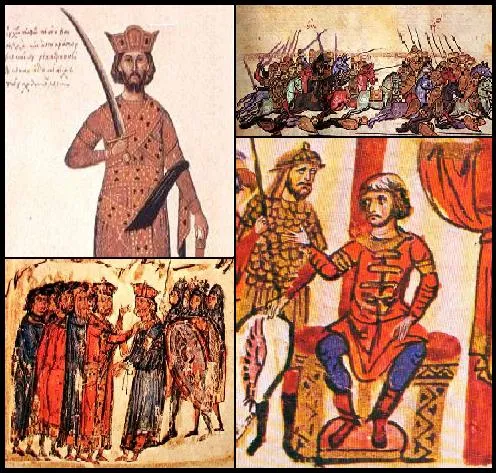
Byzantine–Bulgarian wars
Byzantine–Bulgarian wars: Bulgarian forces led by Tsar Simeon I drove the Byzantines out of Thrace with a decisive victory at the Battle of Achelous.
In context
- When
- Wednesday, August 20 9171109 years ago
- Category
- Historical eventA dated happening — a battle, treaty, launch, discovery, disaster or decision — recorded on this calendar day.
- Era
- 10th century · 910s
- Calendar
- Julian — as recorded at the time
- Recorded from
- Wikipedia “On this day” feed
Dates before 15 October 1582 are in the Julian calendar, so the weekday shown follows the Julian reckoning of the time.
At a glance
Dates: From 917.
What happened
The Byzantine–Bulgarian wars were a series of conflicts fought between the Byzantine Empire and the Bulgarian Empire which began already in the late 5th century when the Bulgars defeated a 15.000 Roman army led by Magister Aristus. The Bulgars permanently conquered parts of the Balkan Peninsula after 680 AD. The Byzantine and First Bulgarian Empire continued to clash over the next century with varying success, until the Bulgarians, led by Krum, inflicted a series of crushing defeats on the Byzantines.
August 20 through the years
Other entries on the same calendar day, in order.
- 917Byzantine–Bulgarian wars
- 2002Saddam Hussein
- 2006Sri Lankan civil war
- 2007China Airlines Flight 120
- 2008Spanair Flight 5022
- 2011First Air Flight 6560
- 20122012 Yare prison riot
- 2014Hiroshima Prefecture
- 2016August 2016 Gaziantep bombing
- 2018Silent Sam
- 2020Joe Biden
Sources
- Wikipedia article (text, CC BY-SA 4.0)
- Licence: CC BY-SA 4.0 for adapted text · how we source this
Cite this page
“Byzantine–Bulgarian wars”, What's On This Date, https://whatsonthisdate.com/app/event/byzantine-bulgarian-wars-917-august-20, accessed October 25, 2026.
Cite the underlying source as well — the source links above go to the record this entry is adapted from.
Questions about this entry
When did Byzantine–Bulgarian wars happen?
August 20 917 — 1109 years ago, on a Wednesday.
Is this a Julian or a Gregorian date?
It is the date as recorded at the time, on the Julian calendar. The Gregorian equivalent falls about ten days later; sources from different countries may give either.
Where does this text come from?
Wikipedia “On this day” feed. Summaries are short adaptations that link back to the source, not reprints.
How do I cite this page?
Use the ready-made citation near the sources at the bottom of the page, and follow the source link to cite the underlying record as well.
One entry a day, by email
The standout entry each morning. Kept for this site only.
Text adapted from Wikipedia under CC BY-SA 4.0 and from Wikidata (CC0). Images come from Wikimedia Commons; credit and licence are shown with each image. Editorial entries are © What's On This Date. Sources & licensing · How this site works.